Is a Line Array Actually Just a Point Source?
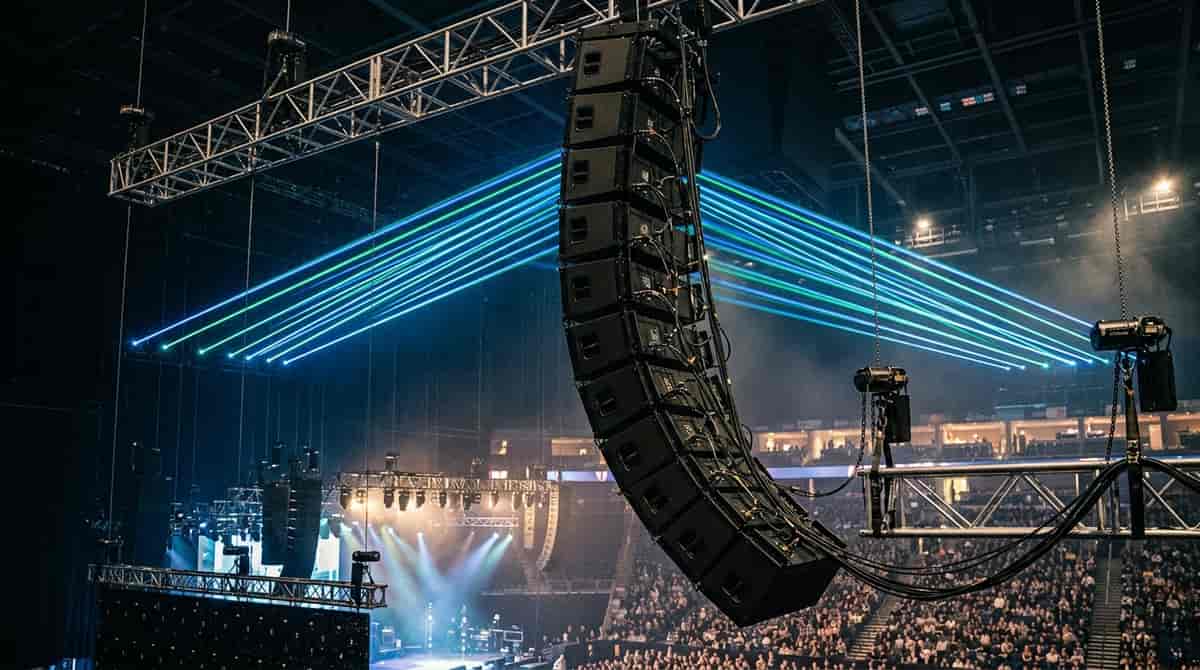
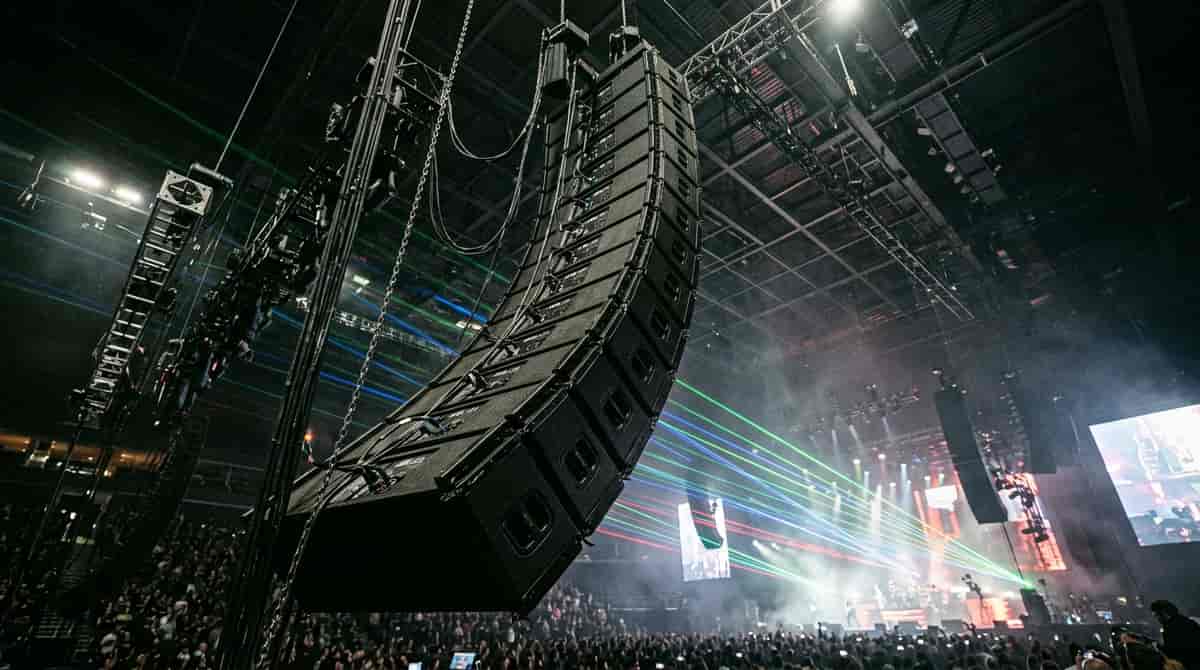
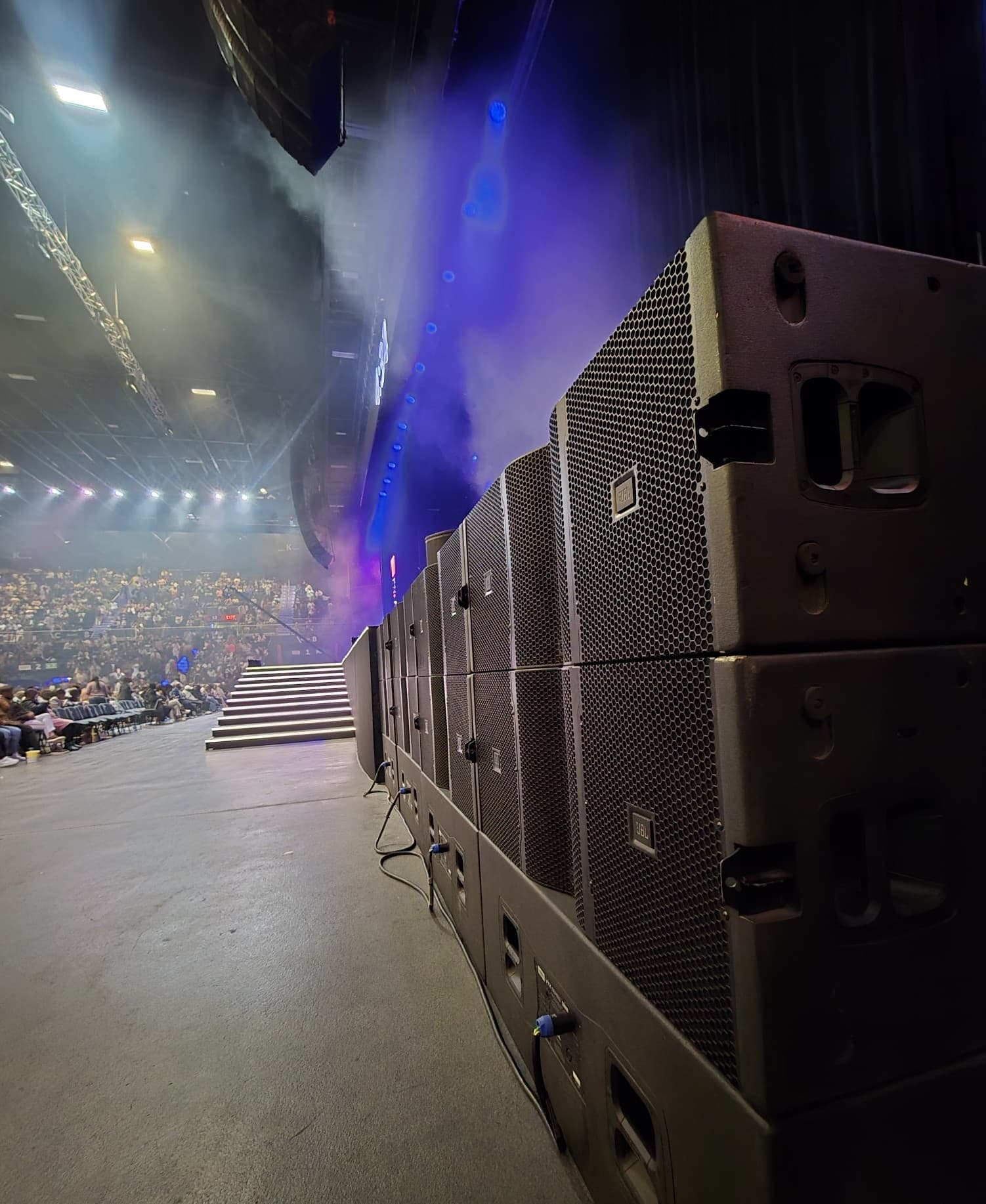
Depending on where you stand in an arena, the exact same speaker array is both a line source and a point source.
The most shocking revelation for junior audio engineers is this: A line array is not a line source forever.
Marketing brochures from speaker manufacturers love to claim that their line arrays project sound infinitely at a -3 dB drop per doubling of distance (cylindrical propagation). This implies a magic bullet that defies the laws of physics.
The reality is far more complex, highly frequency-dependent, and requires a deep understanding of acoustic spatial transitions. Depending entirely on where you are physically standing in a venue, a massive concert line array acts as a line source, and then smoothly transitions into a massive point source.
The Dual Nature of a Single Box
Before we even discuss a massive 24-box array, we must look at a single line array enclosure in isolation.
A single line array box is a schizophrenic piece of technology.
- The High Frequencies (HF): Due to the internal DOSC waveguide (or similar planar wave generator), the high frequencies exit the box as a perfectly flat, isophasic ribbon. For these tiny wavelengths, the single box acts as a line source.
- The Low Frequencies (LF): The 10-inch or 12-inch woofers in the same box generate long wavelengths that wrap around the cabinet. To these long waves, the physical box is tiny. Therefore, the LF exits the box behaving entirely as an omnidirectional point source.
When we start stacking these boxes together, we are attempting to force the LF point sources to couple together and act as a unified line source.
The d-Border: The Transition in Space
When an array is properly deployed (adhering to Wavefront Sculpture Technology), the boxes couple and generate a cylindrical wavefront. We call this the Near-Field (or Fresnel region).
In the near-field, the array is a true line source. It loses only 3 dB per doubling of distance.
However, physics dictates that a cylinder cannot expand infinitely. At a specific distance, the top and bottom edges of the cylindrical wave begin to "bleed" outward, and the wave rounds off into a sphere. This transition point is called the d-border.
The Point Source Reveal: Once the sound wave crosses the d-border and enters the Far-Field (Fraunhofer region), the wave becomes spherical. The entire massive line array stops behaving like a line source and begins behaving exactly like a giant point source, losing 6 dB per doubling of distance.
A Moving Target
The d-border is not a fixed line on the floor of the arena. It is wildly frequency-dependent.
Because the d-border's distance is proportional to the square of the array length divided by the wavelength, high frequencies (which have tiny wavelengths) maintain their cylindrical line-source behavior much further into the room than low frequencies.
If your array is physically too short, the d-border for your low-mids (e.g., 250 Hz) might only be 8 meters away from the stage.
- A VIP standing 5 meters away (in the near-field) hears the 250 Hz as a line source (-3 dB drop).
- A general admission guest standing 20 meters away (in the far-field) hears the 250 Hz as a point source (-6 dB drop).
By the time the sound reaches the back of the room, the low-mids have decayed at twice the rate of the highs. The mix sounds thin, harsh, and abrasive.
Engineering the Transition
This is why technical production is an engineering discipline. At Meyat Sound, our goal is to design an array long enough that the d-border for the lowest critical frequency is pushed all the way to the back wall of your venue.
When you hire us for your corporate AGM or major live event, we guarantee that every listener in the room remains safely inside the near-field, experiencing the true line source behavior you paid for.