The Inverse Square Law in Event Audio
Why your event's front row is deafened while the back row hears nothing, and how to fix it.
For corporate event planners, purchasing AV services can feel like buying a black box. Quotes are filled with technical jargon, and decisions are often made based on price or aesthetics.
However, the most critical factor in your event's audio success isn't the brand of the speaker; it's a fundamental principle of physics known as the Inverse Square Law. Understanding this law is the difference between an engaged, comfortable audience and a room full of attendees complaining about the volume.
The Inverse Square Law Explained
Imagine a lightbulb radiating light spherically in all directions. As the light wave expands outward, its energy must cover an increasingly larger surface area. Therefore, the intensity of the light drops dramatically the further away you move.
Sound behaves identically. When a standard Point Source speaker emits a spherical wave, the acoustic energy expands exponentially. The Inverse Square Law dictates that every time the distance from the speaker doubles, the Sound Pressure Level (SPL) drops by exactly 6 decibels (dB).
What This Means for the Buyer
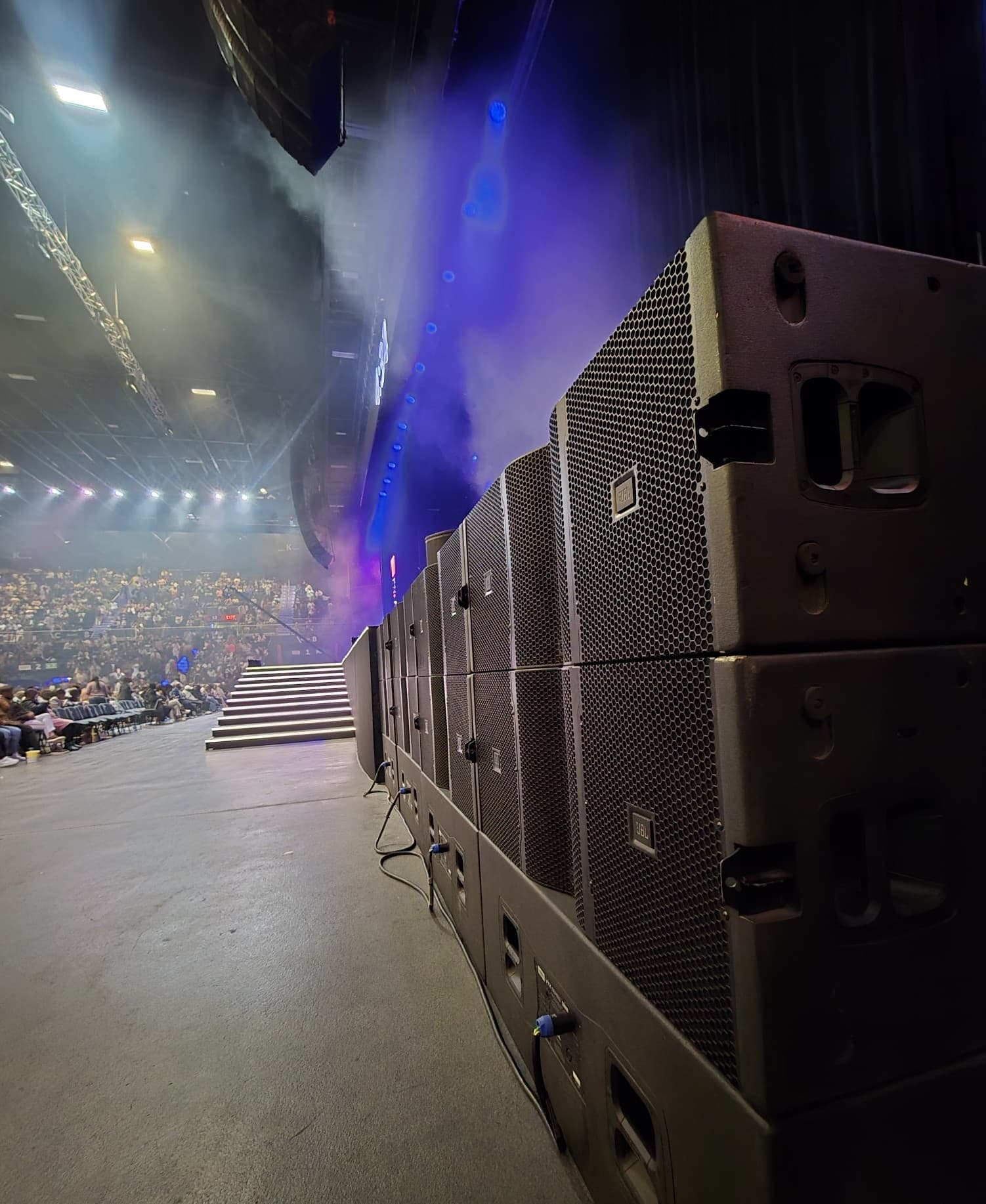
Let's assume you have a 30-meter-deep ballroom for a corporate AGM, and your AV supplier quotes two standard point source speakers on tripods.
To ensure the executives in the back row (at 32 meters) can clearly hear the presentation at a comfortable 80 dB, we must work backward using the Inverse Square Law (+6 dB for every halving of distance):
- Back Row (32 meters): 80 dB
- 16 meters: 86 dB
- 8 meters: 92 dB
- 4 meters: 98 dB
- 2 meters: 104 dB
- Front Row (1 meter): 110 dB
To provide adequate volume for the back row, the front row must be subjected to 110 dB of acoustic pressure. 110 dB is the equivalent of a rock concert or a jackhammer. The front row will be physically uncomfortable, unable to speak to one another, and highly agitated.
The "Turn It Down" Paradox: When the front row inevitably complains and asks the tech to "turn it down," the back row will instantly lose intelligibility and complain they cannot hear the CEO. The technician is trapped by physics.
The Line Source Solution
How do we break the Inverse Square Law? We change the shape of the sound wave.
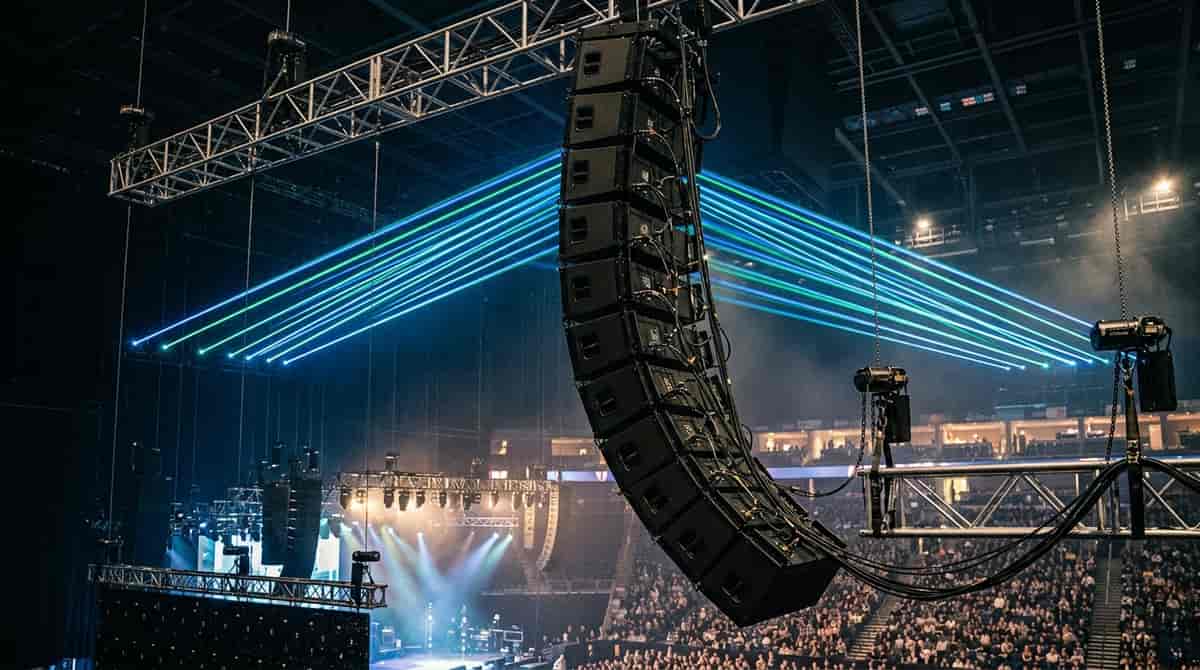
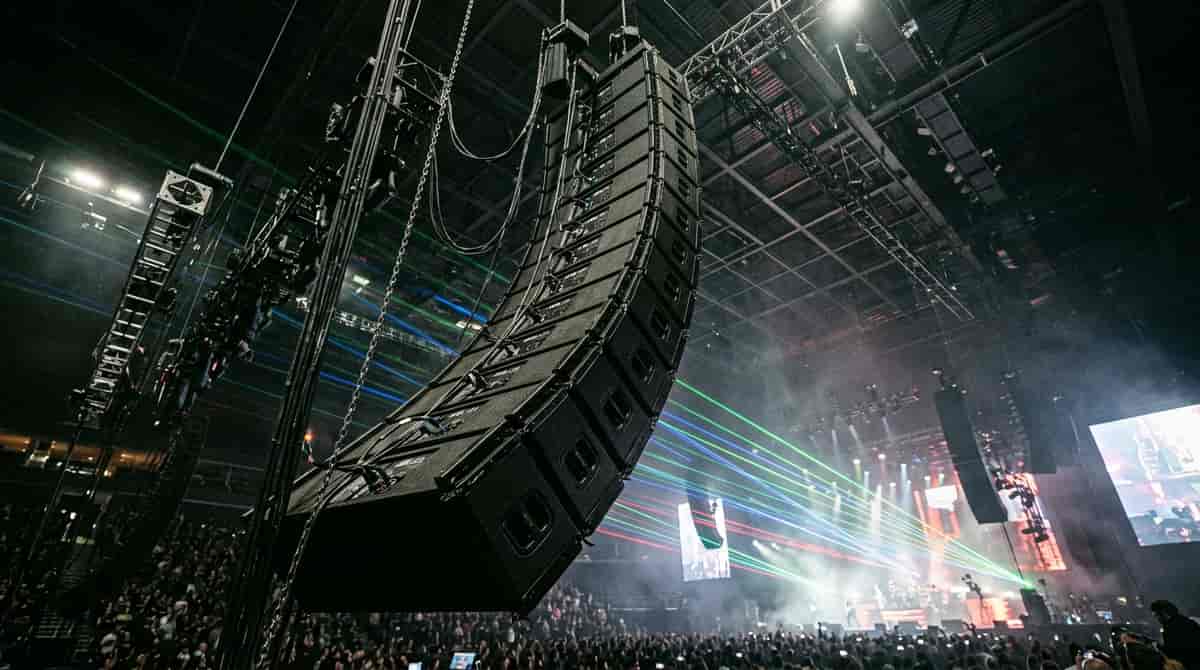
By deploying a properly engineered Line Array system, we force the sound to propagate as a cylindrical wave (in the near field) rather than a spherical wave. Because the energy is constrained vertically and only expands horizontally, a cylindrical wave only loses 3 dB every time the distance doubles.
Let's run the same ballroom scenario with a line array, aiming for 80 dB in the back row:
- Back Row (32 meters): 80 dB
- 16 meters: 83 dB
- 8 meters: 86 dB
- 4 meters: 89 dB
- 2 meters: 92 dB
- Front Row (1 meter): 95 dB
By shifting to a line source, we have reduced the volume hitting the front row from a deafening 110 dB to a comfortable 95 dB, while maintaining perfect clarity for the back row.
If you are unsure which system your next production requires, partner with Meyat Sound. Our engineers use 3D acoustic mapping to guarantee perfect SPL coverage, ensuring absolute comfort for every attendee.