Why 'Line Arrays' Are Not Always a Selling Point
The harsh acoustic reality of deploying only two boxes per side.
In the current event production market, the term "line array" has become a powerful marketing buzzword. Many event planners, agencies, and technical directors will explicitly request a line array on their technical riders, assuming it automatically guarantees superior sound quality.
Unfortunately, many AV suppliers capitalize on this by deploying severely compromised "line arrays" that actually sound significantly worse than a standard point-source system. The most common and egregious offense is the "2-box line array."
The Myth of the 2-Box Array
Walk into any mid-sized corporate event, and you are likely to see a small truss structure hanging a tiny line array consisting of only two (or sometimes three) speaker boxes per side.
The supplier will proudly tout that they have provided a line array. However, a 2-box array fundamentally fails to operate as a line source, particularly in the critical low and low-mid frequencies.
The Problem with Line Length
For a line array to control the directivity of a sound wave and project it as a cylindrical beam (maintaining energy over long distances), the physical length of the array must be comparable to the wavelength it is trying to control.
- High frequencies have very short wavelengths (centimeters) and are easily controlled by the internal waveguides of the individual boxes.
- Low-mid frequencies (e.g., 200 Hz) have wavelengths of roughly 1.7 meters.
If you hang only two small line array boxes, the total length of the array might only be 60 centimeters. It is physically impossible for a 60cm array to control a 1.7m wavelength.
The Acoustic Result: The low-mid energy, having no pattern control, spills chaotically in all directions (omni-directional), bouncing off the ceiling and back wall to create a muddy wash. Meanwhile, the high frequencies remain tightly beamed at the audience. The resulting sound is incredibly unbalanced: shrill, harsh, aggressive highs with absolutely no low-mid warmth or punch.
Comb Filtering and the Spacing Issue
Furthermore, line array boxes are designed to couple acoustically with the boxes immediately above and below them. When you only use two boxes, the listener is heavily exposed to the physical distance between the acoustic centers of the drivers.
Because the array is not long enough to form a cohesive, continuous wavefront, the sound arrives at the listener's ear from the top box a fraction of a millisecond before the sound from the bottom box. This time-arrival difference causes severe comb filtering—where certain frequencies cancel each other out entirely, while others artificially sum together. The audio sounds hollow, "phasey," and abrasive.
The Optimal Line Length
So, how long should a line array be?
There is no arbitrary number of boxes. The optimal line length is dictated entirely by the physics of the venue and the lowest frequency you need the array to control directivity for.
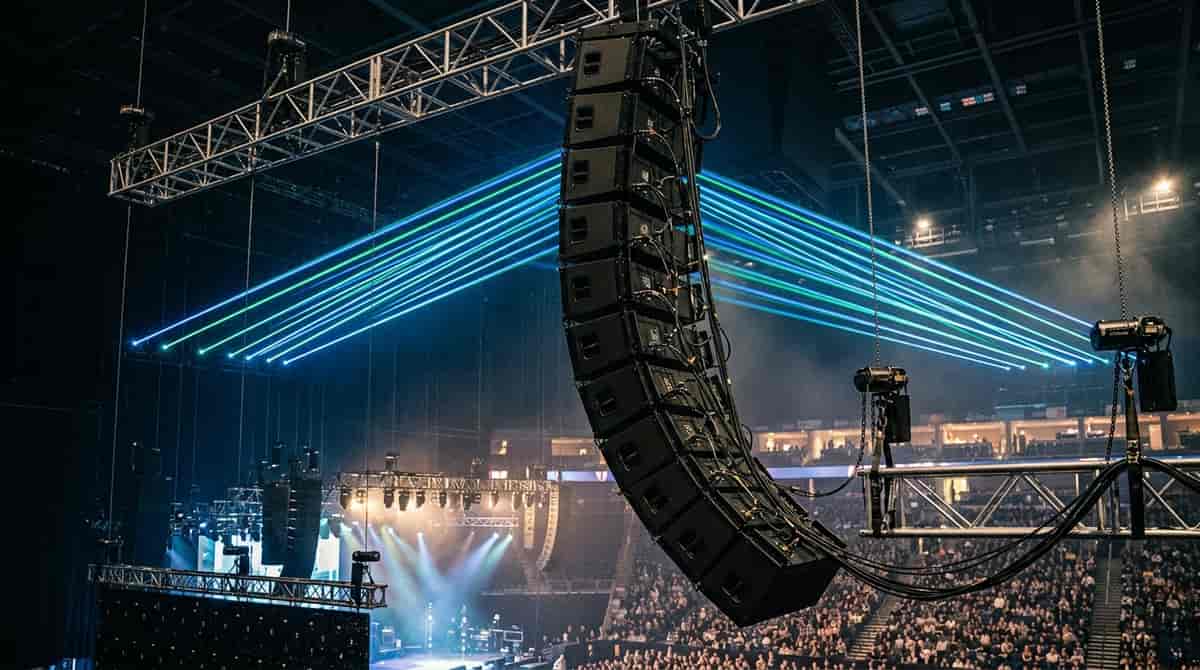
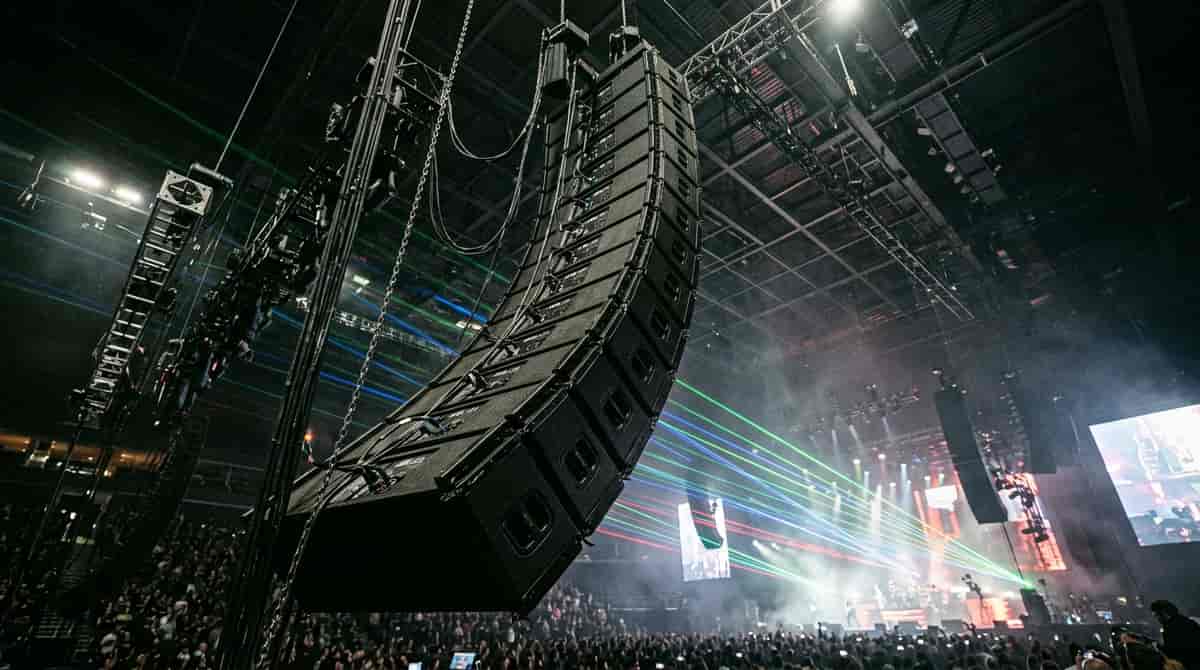
For a true concert-level deployment or a massive outdoor brand activation, engineers aim for a physical line length that exceeds the longest wavelength they wish to control. This often requires arrays of 8, 12, or even 24 boxes per side.
When Point Source is Superior
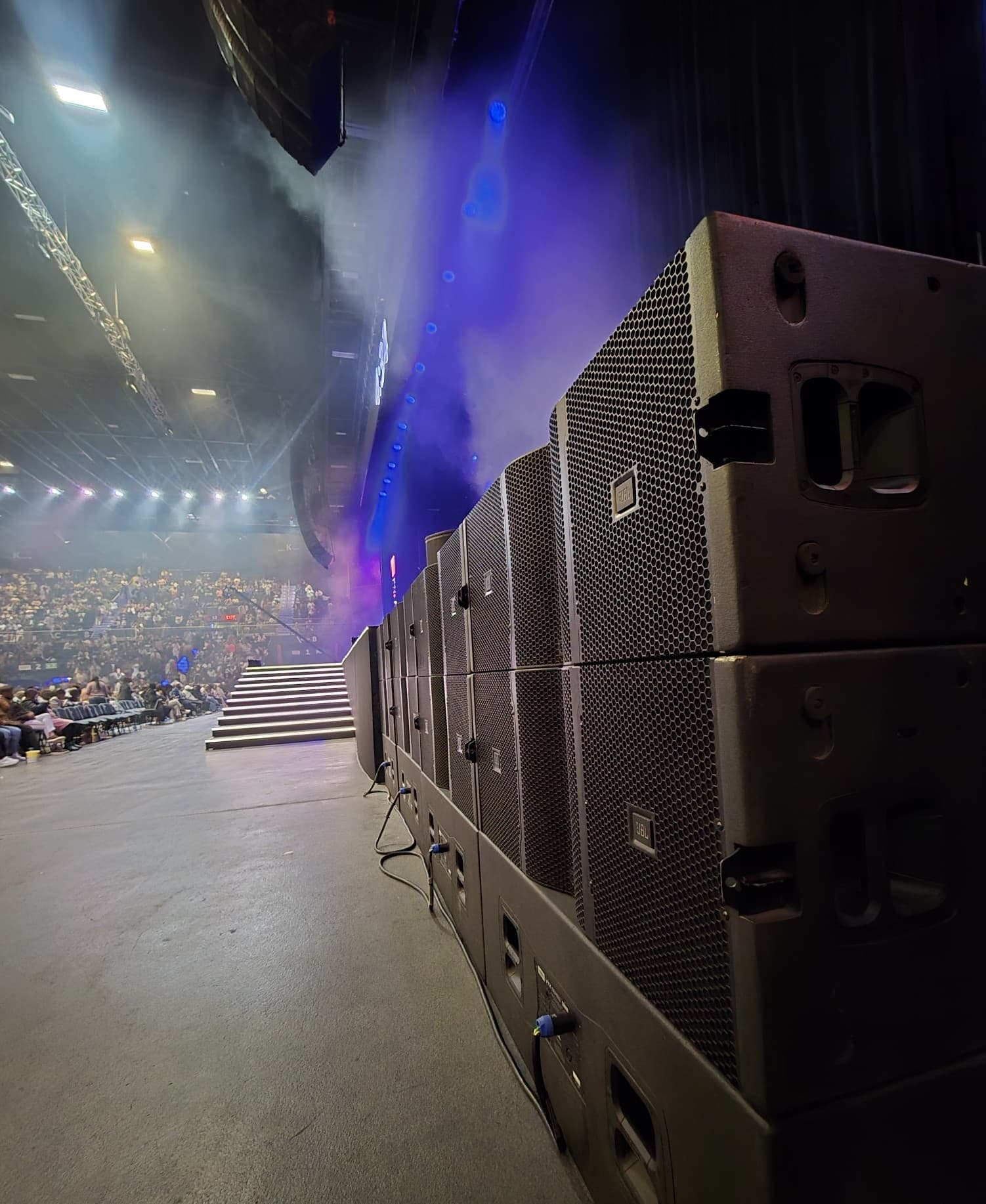
If the budget or venue rigging constraints only allow for a small system, a high-end Point Source system will drastically outperform a 2-box line array.
Point source systems are engineered to provide smooth, coherent coverage from a single acoustic center, eliminating the comb filtering and harshness associated with truncated line arrays.
Do not buy the buzzword. Demand physics.