Line Source Physics: Navigating the 'd' Border
Understanding the transition from cylindrical to spherical propagation in live sound reinforcement.
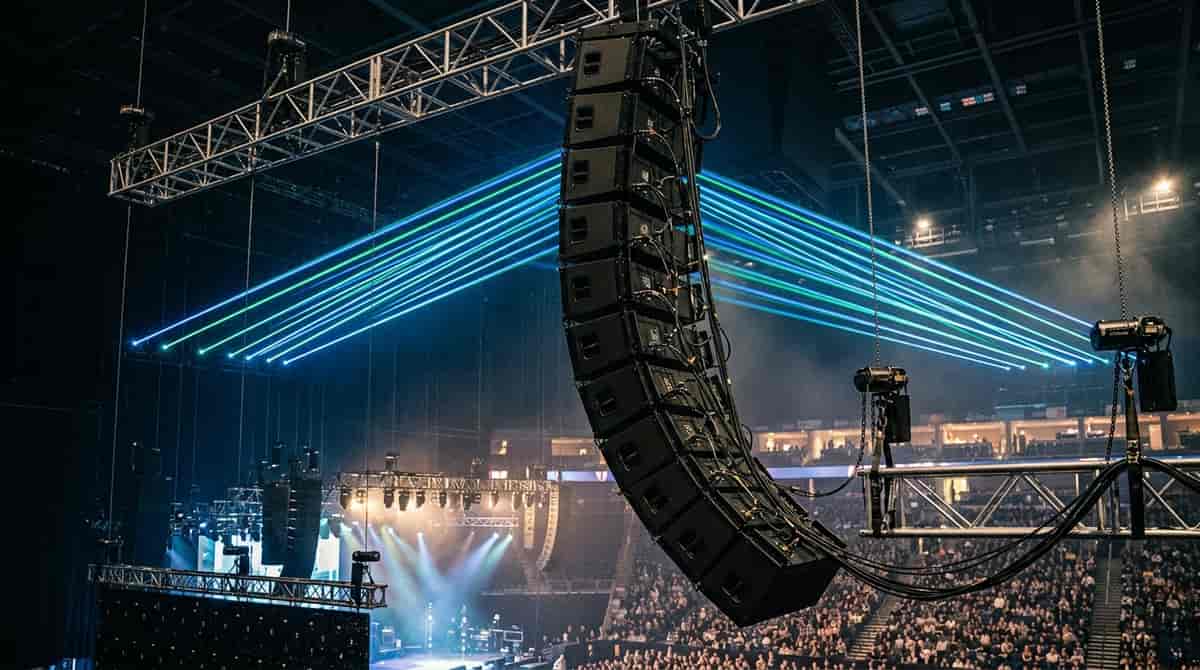
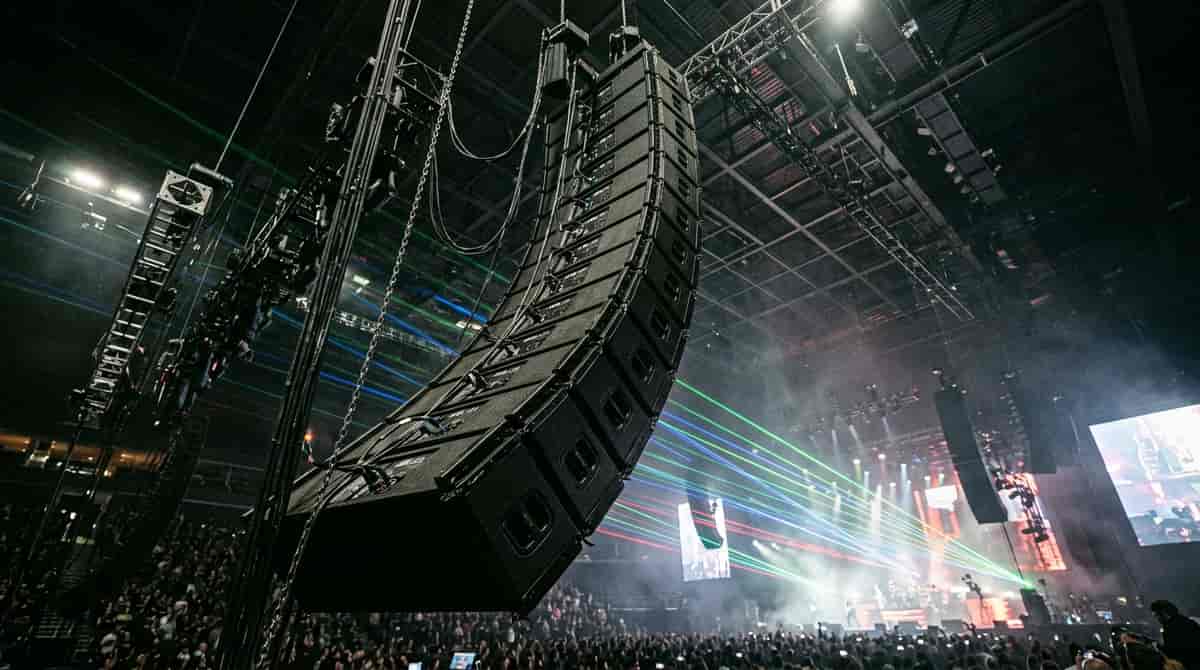
When procuring audio for a massive corporate convention or outdoor festival, buyers are often sold on the visual promise of a "line array." However, simply hanging boxes in a vertical column does not automatically guarantee line source behavior.
To deliver consistent Sound Pressure Level (SPL) and tonal balance from the front row to the very back, we must adhere strictly to the laws of acoustic physics—specifically, the transition between the near field and the far field.
The Fresnel Region (The Near Field)
When multiple loudspeaker enclosures perfectly couple (adhering to Wavefront Sculpture Technology criteria, pioneered by L-Acoustics), they combine to form a single, continuous acoustic ribbon.
In the immediate area in front of this array, known as the Fresnel Region (or near field), the sound propagates as a cylindrical wave. Because energy is constrained vertically and only expands on the horizontal plane, the SPL decreases at an exceptionally slow rate: only 3 dB per doubling of distance.
In the Fresnel region, the physical height of the array is the dominant factor. The listener is essentially inside the "beam" of the array, experiencing immense clarity, impact, and minimal room reflection.
The Fraunhofer Region (The Far Field)
Physics dictates that a cylindrical wave cannot expand infinitely. Eventually, the acoustic energy begins to disperse in both the horizontal and vertical dimensions, breaking the cylinder and transitioning into a spherical wave.
This area is called the Fraunhofer Region (or far field). Once the wave becomes spherical, the array behaves similarly to a massive point source, and the SPL begins to drop at the standard 6 dB per doubling of distance (the Inverse Square Law).
The 'd' Border: The Critical Transition
The exact point where the Fresnel region ends and the Fraunhofer region begins is known as the 'd' border.
This transition distance is not fixed; it is entirely dependent on two variables:
- The Frequency: Higher frequencies maintain cylindrical propagation much further than low frequencies.
- The Length of the Array: The 'd' border distance is proportional to the square of the array's physical length.
The Engineering Reality: If your array is physically too short, the 'd' border collapses inward. The low-mid frequencies will almost immediately transition into spherical waves (losing 6dB per doubling of distance), while the high frequencies remain cylindrical (losing 3dB). By the time the sound reaches the back of the venue, the mix will sound shrill, harsh, and completely devoid of low-end warmth.
Why Array Length is Non-Negotiable
This is why experienced system engineers refuse to deploy short "stubby" arrays for long-throw applications.
To push the 'd' border deep into an arena or festival field and maintain consistent tonal balance across all frequencies, the physical line length must be extended. Adding boxes to an array isn't just about making it "louder"; it is a mathematical requirement to control long low-frequency wavelengths.
At Meyat Sound, our deployments are mathematically modeled in 3D prediction software to ensure the 'd' border exceeds your farthest listener, guaranteeing broadcast-quality audio for every attendee.