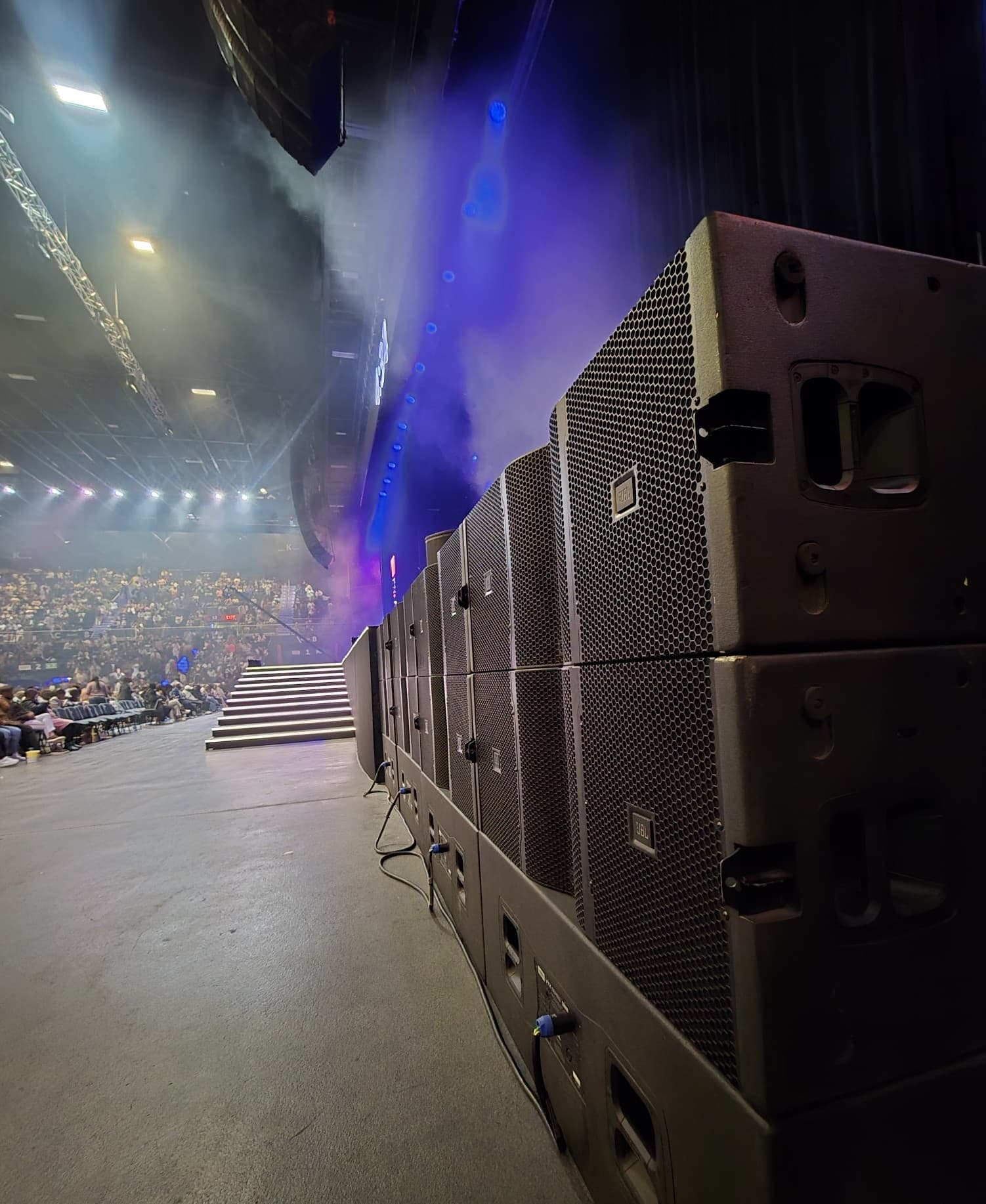
Line Array vs. Point Source: Which Sound System Does Your Event Need?
Stop guessing on your technical riders. Understand the physics of sound dispersion to guarantee perfect audio coverage.
For many event planners and white-label agency partners, specifying an audio system is a daunting task. The choice often boils down to asking for "two speakers on stands" or demanding a "flown line array" simply because it looks impressive.
However, choosing the wrong audio topology for a specific venue or crowd size will result in disastrous acoustics—either deafening the front row while the back row hears nothing, or creating a muddy wash of reverberation.
To ensure crystal-clear audio at your next production, here is a technical breakdown of Line Array vs. Point Source systems, and when our audio engineers deploy each.
What is a Point Source System?
A point source system consists of individual speaker cabinets (often placed on tripods or stacked on subwoofers) where the sound radiates outward from a single point in a spherical pattern—much like a flashlight beam spreading out.
The Physics
Because the sound spreads out spherically, point source speakers obey the Inverse Square Law. This physics principle states that every time the distance from the speaker doubles, the sound pressure level (SPL) drops by 6 decibels (dB).
This means that to make the sound loud enough for a person standing 30 meters away to hear clearly, the speaker must be blaring at an incredibly high volume, which will deafen the person standing 3 meters away in the front row.
When to Use Point Source
- Small to Medium Indoor Events: Corporate breakouts, intimate weddings, and venues with capacities under 300 people.
- Short Throw Distances: When the distance from the speaker to the back row of the audience is relatively short.
- Low Ceiling Venues: If a venue cannot accommodate overhead rigging, point source systems are the only viable option.
What is a Line Array System?
A line array is a group of specialized speaker cabinets hung vertically in a curve (often resembling a banana).
The Physics
Instead of radiating sound spherically, a properly configured line array creates a cylindrical sound wave. Due to complex acoustic coupling and phase alignment between the cabinets, a line array only loses 3 dB every time the distance doubles (compared to the 6 dB loss of a point source).
This is a game-changer. It means we can project sound massive distances over a crowd, ensuring the person in the back row hears the music at almost the exact same volume as the person in the front row.
Furthermore, the vertical dispersion of a line array is incredibly tight. We can aim the sound exactly at the audience and avoid hitting the ceiling or upper walls. This drastically reduces nasty acoustic reflections and echo in highly reverberant venues (like the Sandton Convention Centre or large warehouses).
When to Use Line Arrays
- Large Scale Events & Concerts: Any event with an audience over 500 people or an audience area deeper than 30 meters.
- Highly Reverberant Halls: When you need to keep sound off the walls and ceiling to maintain speech intelligibility.
- Major Corporate AGMs: Where flawless, even coverage across a massive seating area is non-negotiable.
The "Ground-Stacked" Line Array Myth: You will often see cheap AV companies place a small line array sitting on the ground. This defeats the entire purpose of the system. To work effectively, a line array must be flown (hung from rigging points) high in the air so it can angle down over the audience.
The Hybrid Approach: Delay Towers
What happens if you have a massive outdoor field, but your budget doesn't allow for a colossal main line array? We use "Delay Towers."
We set up a primary point source or small line array system at the main stage. Then, 40 meters into the crowd, we set up a second set of speakers. Our audio engineers use digital signal processors (DSPs) to delay the audio signal going to the second set of speakers by milliseconds. This ensures that the sound wave from the main stage hits the middle audience at the exact same fraction of a second that the delay tower speakers fire, maintaining perfect phase alignment and clarity across massive distances.
Trust the Audio Engineers
As an event professional, you shouldn't have to calculate inverse square laws or phase alignment. That is our job. When you partner with Meyat Sound for your turnkey production services, our systems engineers utilize acoustic prediction software (like EASE) to map your venue and specify the exact audio topology required for flawless coverage.