Array Aiming: Overshooting vs. 0-Degree Coupling
The critical nuances of aiming a massive PA system, and avoiding the dreaded 'HF Death Spike'.
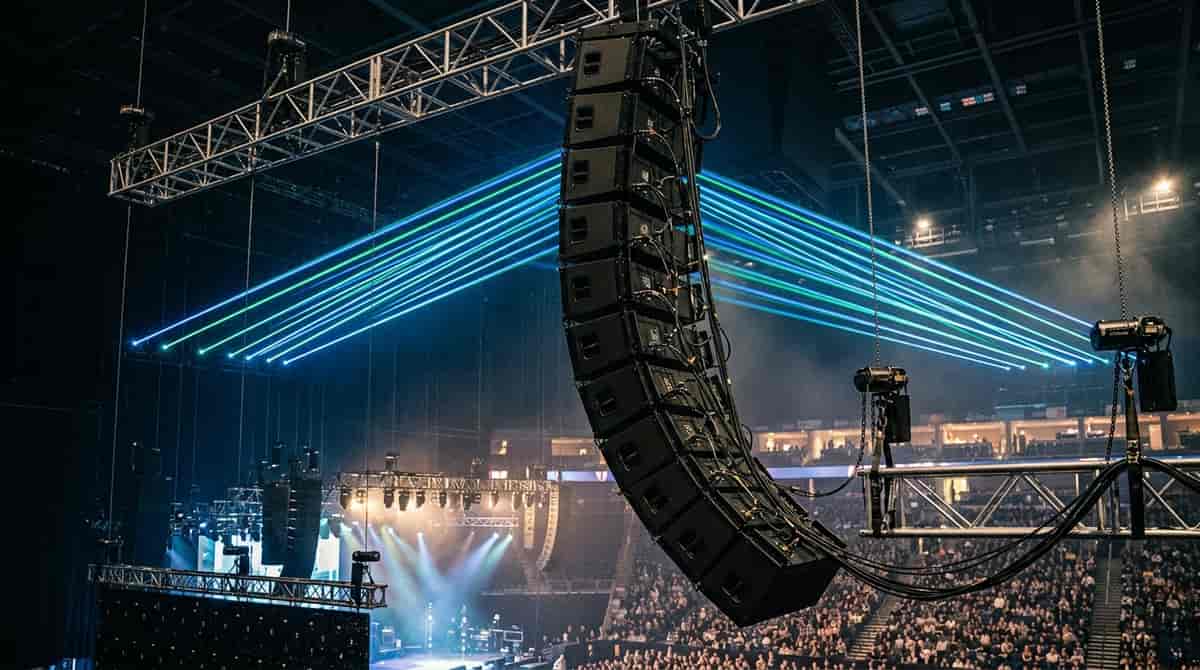
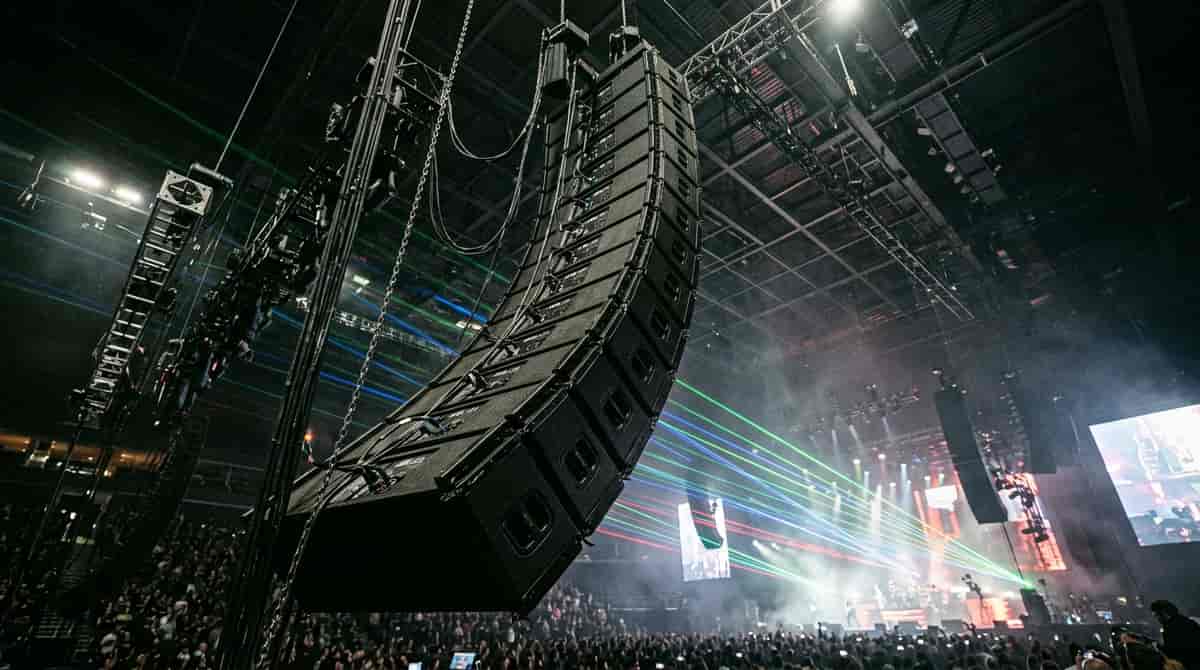
When a massive line array is flown high above an arena floor, every millimeter of curve dictates how the sound will interact with the audience.
Two of the most debated concepts in physical array deployment are "Overshooting" the back row and the use of 0-Degree inter-enclosure angles at the top of the array. Understanding these concepts separates a truly engineered deployment from a chaotic wall of sound.
The Theory of Overshooting
A common mistake made by junior system techs is to aim the very top box of the line array exactly at the farthest row of the audience (e.g., the upper balcony). The logic seems sound: point the speaker exactly where the last listener is sitting.
However, acoustic coupling requires summation. If the top box is aimed exactly at the last row, the listener in that row is only receiving energy from that single box, operating entirely on the downward slope of its vertical dispersion pattern. They are missing the powerful, coherent summation that occurs when multiple boxes interact.
The Engineering Standard: Instead, experienced system engineers "overshoot" the array. We aim the top one or two enclosures slightly above the highest audience member (often hitting the upper back wall). By doing this, the farthest listener is covered by the combined, on-axis summation of the top 3 or 4 enclosures. This guarantees the back row receives a full-frequency, high-impact acoustic image.
The Danger of 0-Degree Coupling
To achieve the maximum possible "throw" distance, it is tempting to set the top three or four boxes of the array to a 0-degree angle (perfectly straight, with no curve between them).
While this absolutely maximizes throw, it creates a severe acoustic problem known in the industry as the "HF Death Spike."
When multiple enclosures are coupled at exactly 0 degrees, their high-frequency planar waves sum together in a perfectly parallel, highly concentrated beam. This beam becomes incredibly narrow and intensely loud.
Breaking the Coupling
To maintain throw distance without generating this destructive high-frequency spike, we introduce micro-splays.
Instead of setting the top four boxes at 0 degrees, a systems engineer will deploy them at 0.5 - 1.0 - 1.0 - 1.5 degrees.
This incredibly subtle curvature is enough to gently break up the perfect parallel coupling of the high frequencies, smoothing out the response and eliminating the spike.
Partner with Meyat Sound, where physics and rigorous modeling dictate every angle.